











Short answer: a kamon (家紋) is a Japanese family crest, a small round emblem that marks a household the way a coat of arms marks a European family. Most are drawn from plants, animals, objects or simple geometry, usually inside a circle. There are well over 20,000 designs, and they still appear on formal kimono, gravestones, shop signs and family heirlooms.
Unlike a coat of arms, a kamon was never reserved for the nobility. By the Edo period ordinary families had one too, and many Japanese families still know theirs today.
Where kamon came from
Court nobles of the Heian period (794 to 1185) began marking their ox carriages and robes with personal designs. In the age of the samurai the crests moved onto banners, armour and tents, so that allies and enemies could be told apart on the battlefield. Through the peaceful Edo period (1603 to 1868) merchants, craftsmen and actors adopted crests of their own, and the kamon became a family emblem for everyone.
The main kinds of kamon
| Kind | Examples | What they suggest |
|---|---|---|
| Plants | Wisteria (fuji), wood sorrel (katabami), paulownia (kiri), hollyhock (aoi), bellflower (kikyo) | The largest group. Wisteria for long life and prosperity, wood sorrel for a family that spreads and thrives |
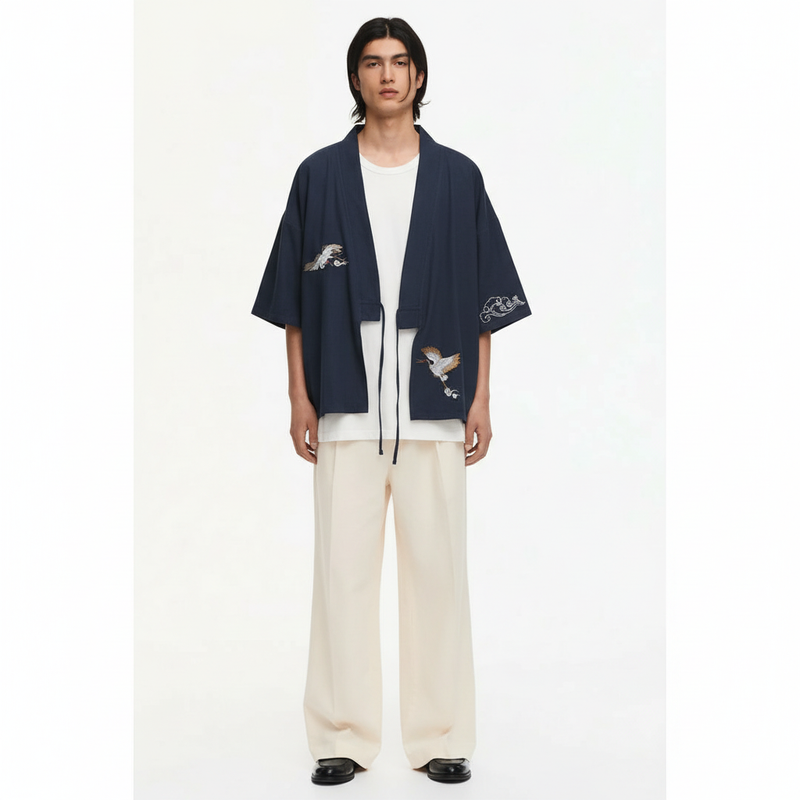
| Animals | Crane (tsuru), butterfly (cho), hawk feathers (takanoha) | Crane for long life, hawk feathers for martial spirit |
| Natural forms | Waves, clouds, snowflakes, mountains | The season, place or character a family identified with |
| Objects | Fans, arrows, wheels, sword guards | A trade, a role or a story in the family history |
| Geometric | Diamonds (hishi), circles, characters | Clean, easy-to-read marks. Many share shapes with the traditional Japanese patterns |
Famous crests you may already know
- The chrysanthemum (kiku): a 16-petal chrysanthemum is the emblem of the Imperial family. It appears on Japanese passports.
- The paulownia (kiri): the paulownia crest is used by the Japanese government and the Prime Minister's office.
- The three hollyhock leaves (mitsuba aoi): the crest of the Tokugawa shoguns, who ruled Japan for over 250 years.
- The bellflower (kikyo): the crest of the Akechi clan, remembered for Akechi Mitsuhide.
Kamon on clothing: the montsuki
The most formal men's kimono is the montsuki, a black kimono with the family crest dyed in white. Five crests (itsutsu mon) are the most formal: one at the centre of the back, one on the back of each sleeve and one on each side of the chest. Three crests or one crest mark less formal versions. With a crested haori and striped hakama, it is what a groom traditionally wears at a wedding. Our guide to the men's kimono explains the rest of the outfit, and the haori guide covers the jacket.
How to find your family crest
- Ask older relatives, and look at family gravestones. In Japan the crest is often carved on the family grave.
- Check heirlooms such as a montsuki kimono, lacquerware or old photographs of formal events.
- If your family has a Buddhist temple, its records may note the crest.
- Crest books and online catalogues sort designs by motif, so once you know the plant or shape you can find the exact variant.
A family name does not decide the crest. Different families with the same surname often use different kamon, and families sometimes adopted a new one.
Using kamon today
Crests still mark formal clothing, family graves, traditional shops and restaurants, sumo wrestlers' kimono and the noren curtains hung over doorways. Many modern logos borrow the round, simple form. For the garments a crest is worn on, see our glossary of traditional Japanese clothing and our hakama pants.