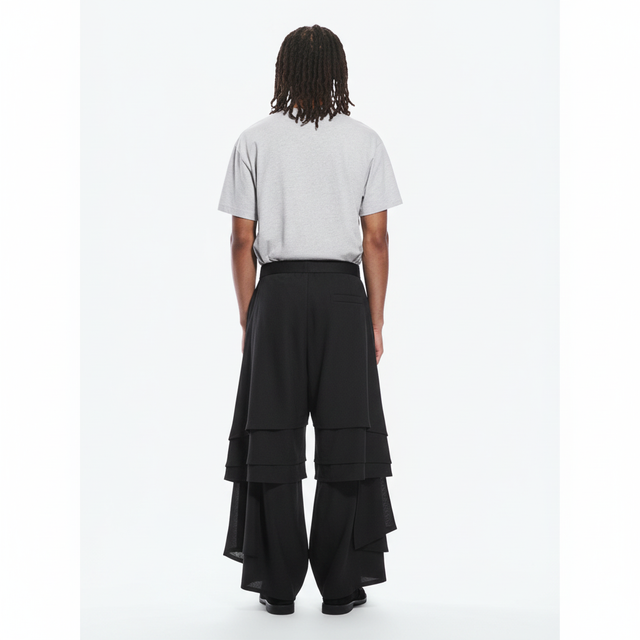
Hakama are the pleated, wide trousers worn over a kimono in Japan - formal dress historically, and still the standard uniform of kendo, aikido and kyudo. The traditional cut is enormously wide, pleated at the front, stiffened at the back with a board called a koshiita, and tied on with long straps rather than fastened with a waistband. Worn properly it reads more like a divided skirt than a pair of trousers, which is the point: it was cut to be sat in, knelt in and moved in.
What survives into modern clothing is the silhouette rather than the construction. You keep the width, the wrap across the front and the ties. You lose the koshiita, the formality and the several minutes it takes to put a real one on.
The one here
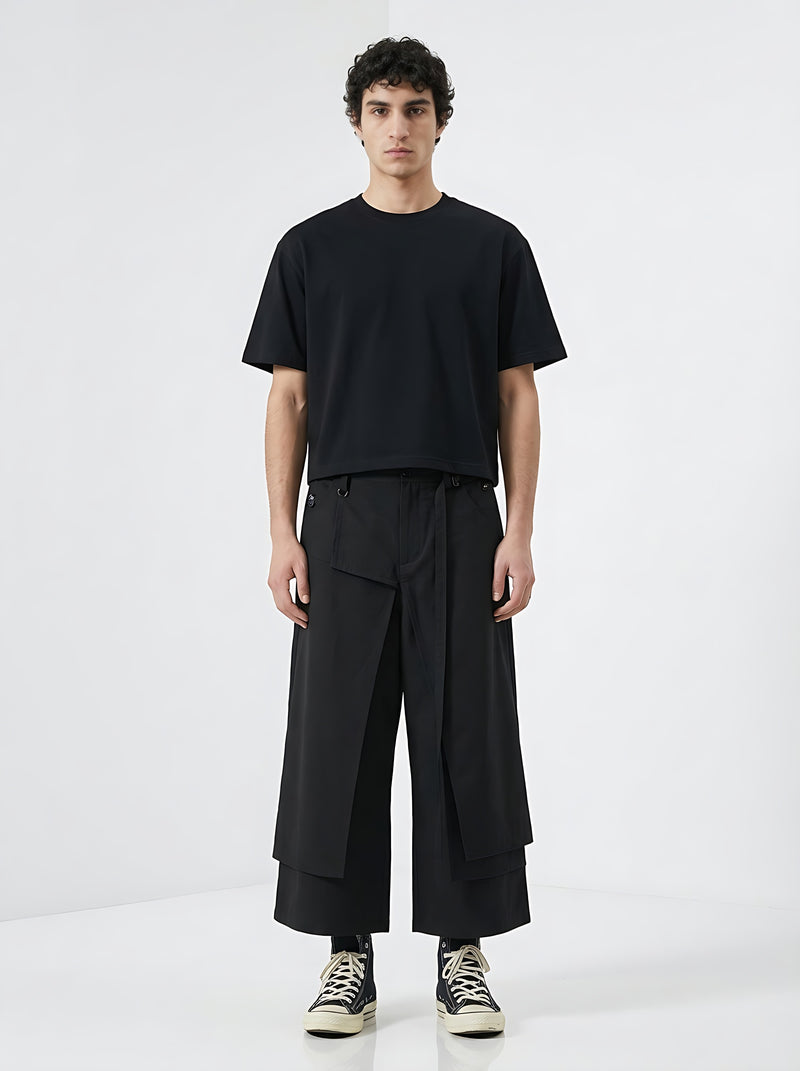
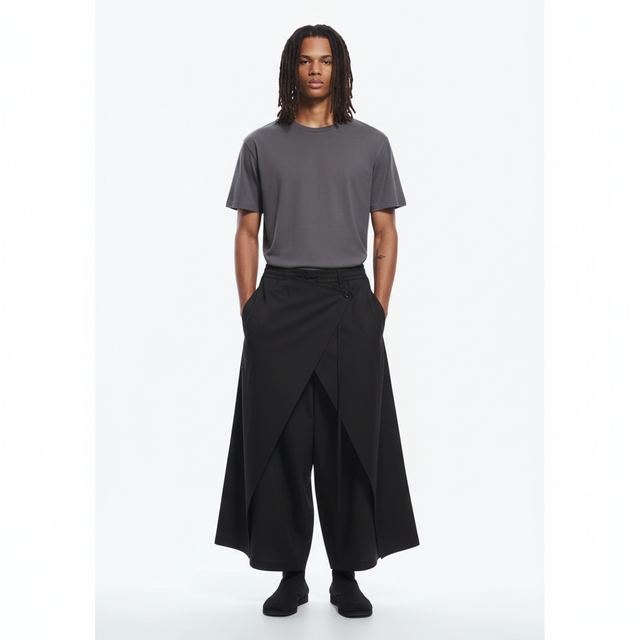
The Men's Dark Cotton Hakama Pants take that shape and make it wearable. A wrap panel crosses the front and falls open over a wide leg underneath, so the trouser reads as a skirt from straight on and as a very wide trouser from the side. Long ties run down the side seam. The waist is elasticated at the back rather than tied on, which is the concession that makes it a trouser you can put on in one movement, and there is a single welt pocket behind.
The cotton has a little stretch in it and holds the fall of the wrap without stiffness. It is black throughout, cut relaxed, and the leg stops at the ankle rather than breaking over the foot. Sizes run XS to XL.
Hakama, harem and samurai pants
These three names get used for each other constantly and they are not the same cut. A hakama is wide the whole way down and wraps at the front. A harem pant is wide at the hip and gathers back in at the ankle - the opposite ending. Samurai pants is not a garment name at all; it is what people search when they mean hakama, because that is what they have seen on screen. Hakama vs harem pants takes the two cuts apart properly, and what are samurai pants called covers the naming.
How to wear them
The trouser is the whole outfit, so everything above it should be quiet and reasonably close to the body - a plain tee, or a fitted crew. Put a loose top over a loose bottom and the shape disappears. Because the leg stops at the ankle it sits over a low, plain shoe without needing to be broken or cuffed. A short jacket works over the top precisely because it ends above the wrap: a haori or a noragi finishes it without cutting across the panel.
Sizing, and what to check
The back is elasticated, so the waist carries a range rather than sitting at one measurement. The figure that decides fit here is not the waist but the length, since the hem is meant to land at the ankle and the wrap panel reads differently if it sits lower. Check the measurements on the product page against a pair you own before choosing - the size chart there is the supplier's own table, transcribed, and it is the number to trust over the letter on the label.
Les mesures proviennent du tableau de tailles à plat du fabricant pour chaque vêtement, converties en centimètres et ramenées sur une même échelle de tailles. Disponible pour 1 vêtement sur 1 ici, vérifié le 2026-09-20. Notre méthode de mesure.
The wide, wrapped trousers traditionally worn over a kimono in Japan, and still the uniform of kendo, aikido and kyudo. A modern pair keeps the width, the front wrap and the ties, and drops the stiffened back panel and the formality.
What is the difference between hakama and harem pants?
A hakama stays wide the whole way down and wraps across the front. A harem pant is wide at the hip and gathers back in at the ankle. They are opposite shapes below the knee.
Are these traditional hakama?
No. These are cut on the hakama silhouette for everyday wear - wrap panel over a wide leg, ties down the side - with an elasticated back waist instead of the traditional straps and stiffened koshiita panel.
What colour and sizes do they come in?
Black only, in sizes XS to XL. There is one pair in the range at the moment.
How long are they?
The leg stops at the ankle rather than breaking over the foot, so they sit over a low, plain shoe without cuffing.






 XSSM+2Men's Dark Cotton Hakama Pants