


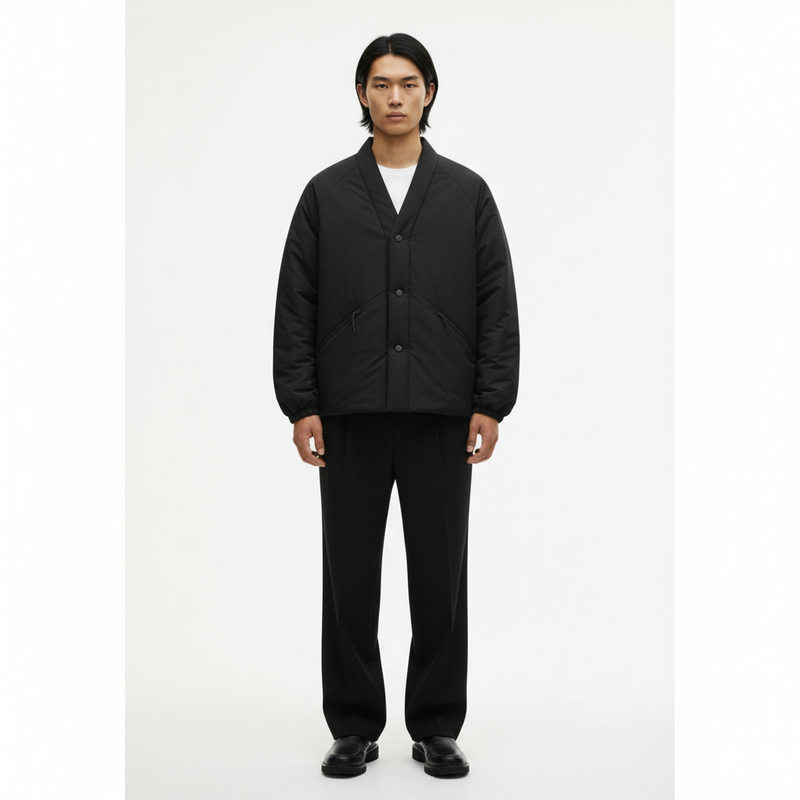

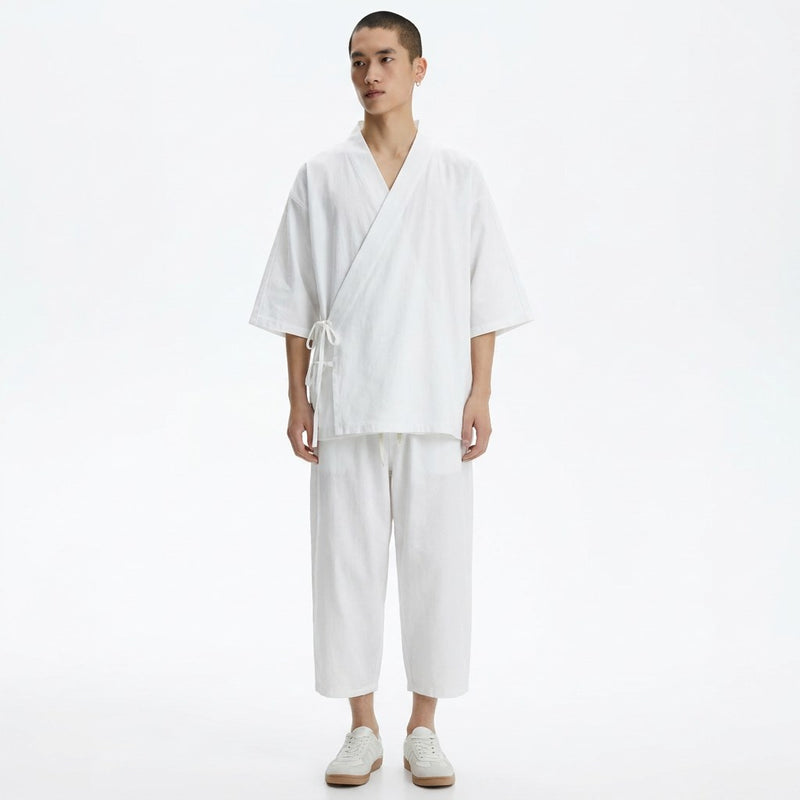


A jinbei (甚平, also written 甚兵衛 and read jinbē) is a Japanese two-piece summer outfit: a short-sleeved top that ties closed at the front, worn with matching shorts. People in Japan wear it at home, around the neighborhood and at summer festivals. You can see current sets in our jinbei collection.
What is a jinbei, exactly?
Think of a jinbei as the summer cousin of the kimono, cut down to what you need on a hot evening. The top wraps like a kimono, left side over right, but the sleeves stop above the elbow and the hem sits around the hips. The bottoms are loose shorts that end near the knee. Nothing is tucked, belted or layered.
It is casual clothing. A jinbei is what a Japanese man might put on after a bath, wear to the corner shop, or wear to watch fireworks with his kids. Children's jinbei are everywhere in July and August, and women's jinbei in brighter prints have become common too. It is not formal wear, and it is not a martial arts uniform.
Parts of a jinbei
- The top (uwagi, 上着): a short wrap jacket with two sets of ties, one inside and one outside, so it closes without a belt.
- Side vents: open slits at the sides of the top let air move.
- Open stitching: on many traditional jinbei the sleeves are joined to the body with a loose lattice stitch instead of a closed seam, another way to stay cool.
- The shorts (hanzubon, 半ズボン): wide, knee-length shorts with an elastic or drawstring waist.
Traditional jinbei are made of cotton or hemp, often in a crinkled weave called chijimi (縮) that keeps the cloth from sticking to damp skin.
When and where people wear a jinbei
- At home in summer: as loungewear or sleepwear on hot nights.
- Summer festivals: natsu matsuri (夏祭り) and fireworks shows, especially for men and children.
- Around the neighborhood: a walk, a trip to the shop, an evening at a local bar.
- Outside Japan: as a relaxed summer set for the beach, the patio or a backyard party.
You would not wear one to a wedding, a funeral or a tea ceremony. For those, Japan turns to kimono, formal haori and the hakama.
Jinbei vs yukata, samue and happi
| Garment | Pieces | Sleeves and length | Typical use |
|---|---|---|---|
| Jinbei (甚平) | Top and shorts | Short sleeves, knee-length shorts | Summer at home, festivals |
| Yukata (浴衣) | One robe plus an obi belt | Wide sleeves, ankle length | Summer festivals, fireworks |
| Samue (作務衣) | Top and long pants | Long sleeves, full-length pants | Temple chores, crafts, everyday wear all year |
| Happi (法被) | Short coat | Wide sleeves, hip length | Festival teams, shop staff, events |

The quick way to tell them apart: a yukata is one long robe, a samue is roughly a jinbei with long sleeves and long pants, and a happi is a jacket, usually printed with a crest or a group name.
Where the name jinbei comes from
Nobody is fully sure. One story credits an Edo-period commoner named Jinbei who wore the garment. Another links the word to the jinbaori (陣羽織), a sleeveless coat that samurai wore over armor. Either way, the matching shorts set most people picture today is a fairly modern version.
The word also named the biggest fish in the sea. The whale shark is jinbeizame (甚兵衛鮫) in Japanese, usually explained as a nod to the garment: the white spots and stripes on its back were said to look like the patterned cloth of a jinbei.
How to wear a jinbei
- Put on the shorts and adjust the waist.
- Wrap the right side of the top across your body first and tie the inside tie at your left hip.
- Bring the left side over it and tie the outer tie at your right hip. The left side must end up on top. Right over left is how the dead are dressed in Japan, so it is the one rule worth remembering.
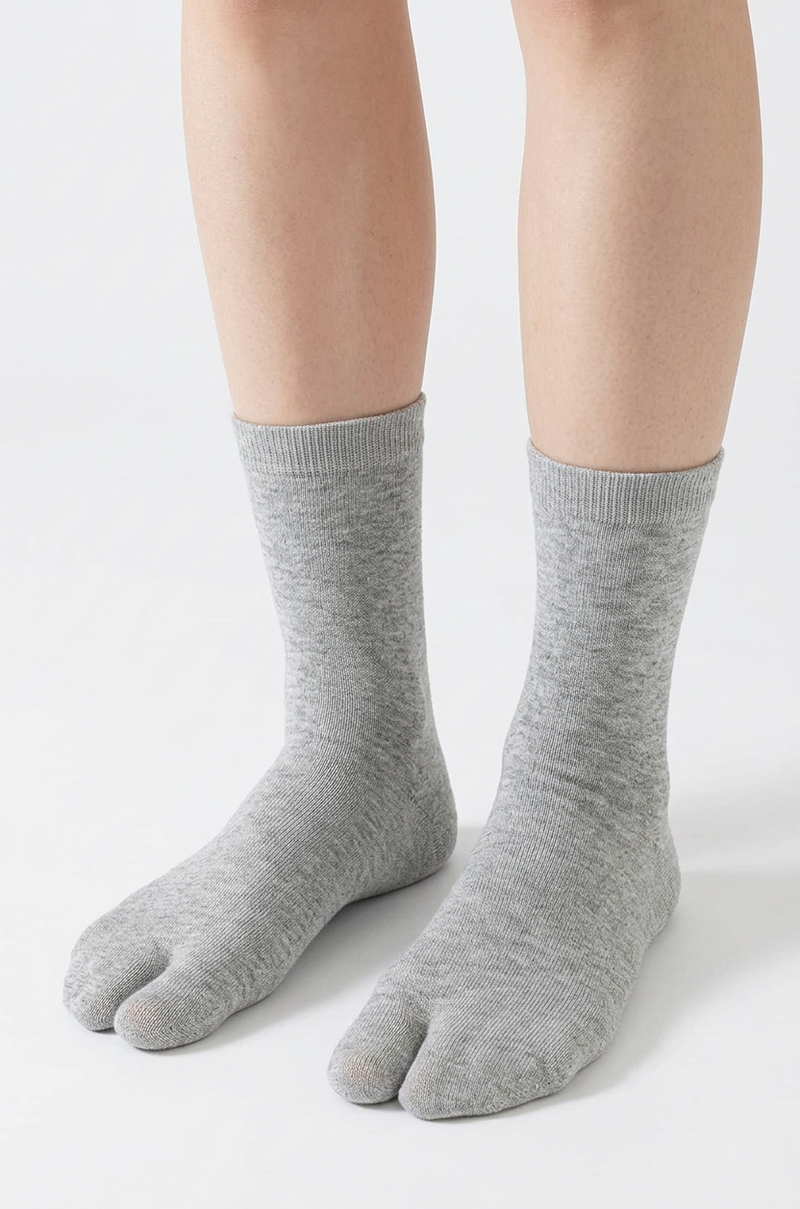
- Add geta, setta or plain sandals. Split-toe tabi socks work if you want something on your feet.
Jinbei sets at Amaji
We sell affordable everyday jinbei sets made in China, priced for lounging and summer events rather than as heirloom pieces. At specialist shops the median men's jinbei is around $76.00, and the cheaper quarter starts near $59.99. Ours:
- Men's Tie-Front Jinbei Set, $64.90 to $79.90, one size.
- Men's Seigaiha Wave Jinbei Set, $52.90, in Black Wave or Grey Wave, sizes XS and S. Seigaiha (青海波) is the classic overlapping wave pattern.
- Men's Jacquard Jinbei Set, $54.90, in Dark Grey, Green Jacquard, Grey Jacquard or Light Grey, sizes XS and S.
Several sets come in a short size range, so check the size list before you choose. If you need a uniform for karate, judo or another dojo, a jinbei is the wrong garment, and our sets are not training gear. To compare other shops, read where to buy a men's jinbei, or browse the full jinbei collection.
Written by the Amaji team, October 18, 2026. How we write our guides.