










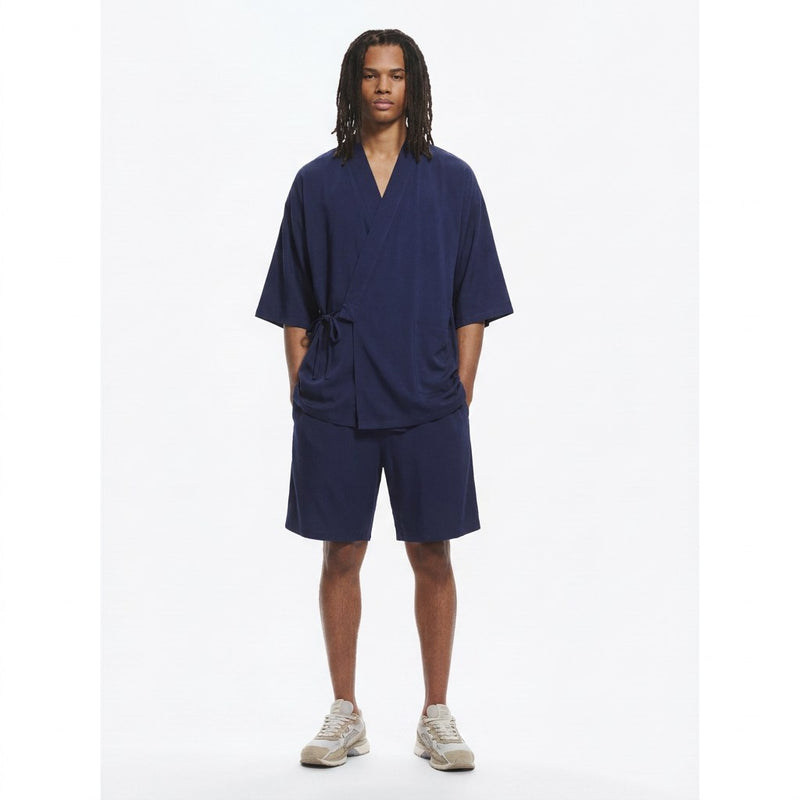

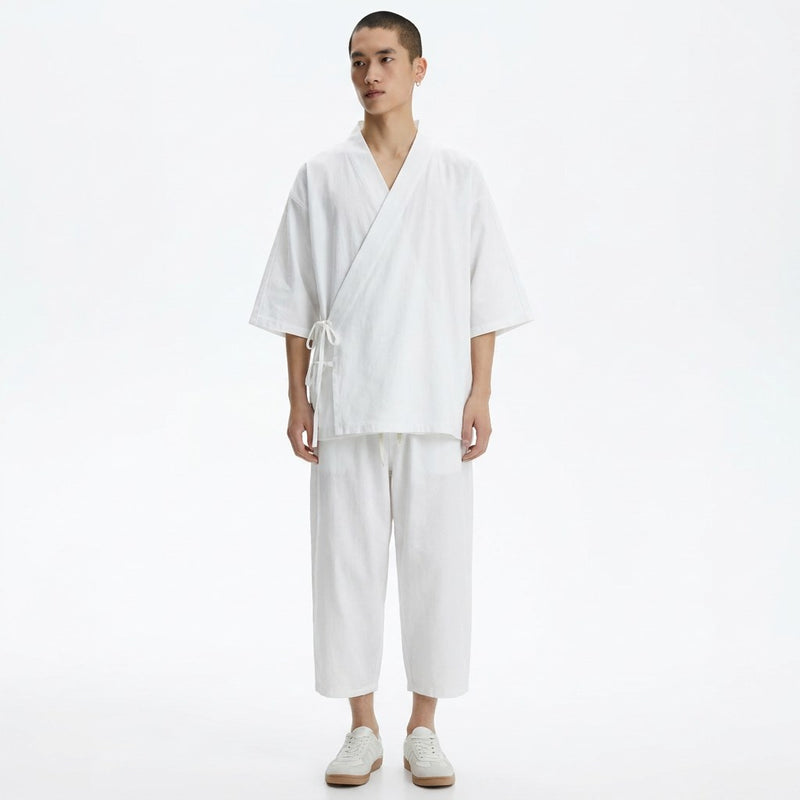
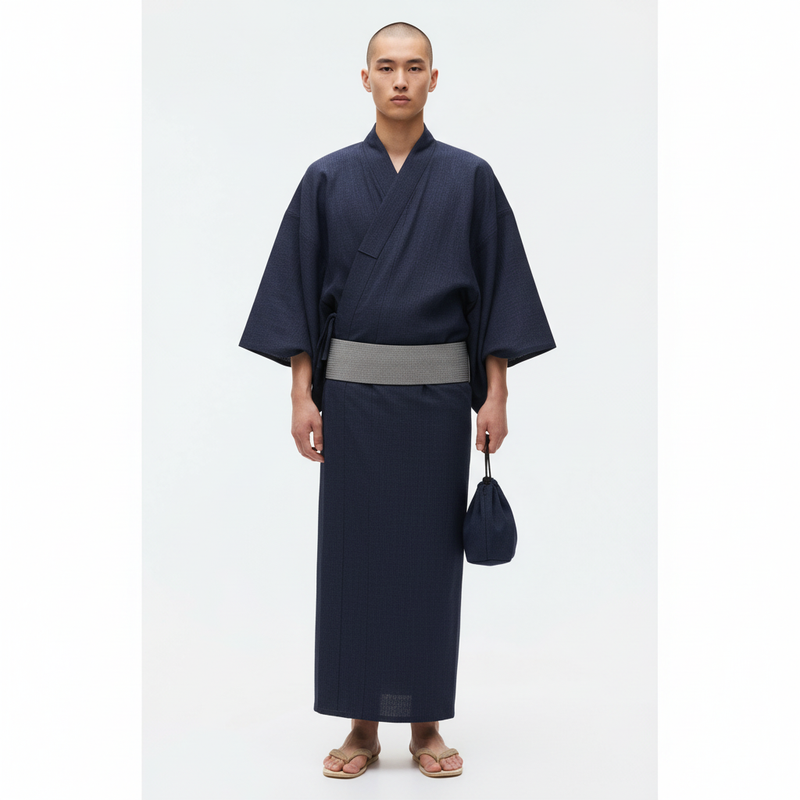
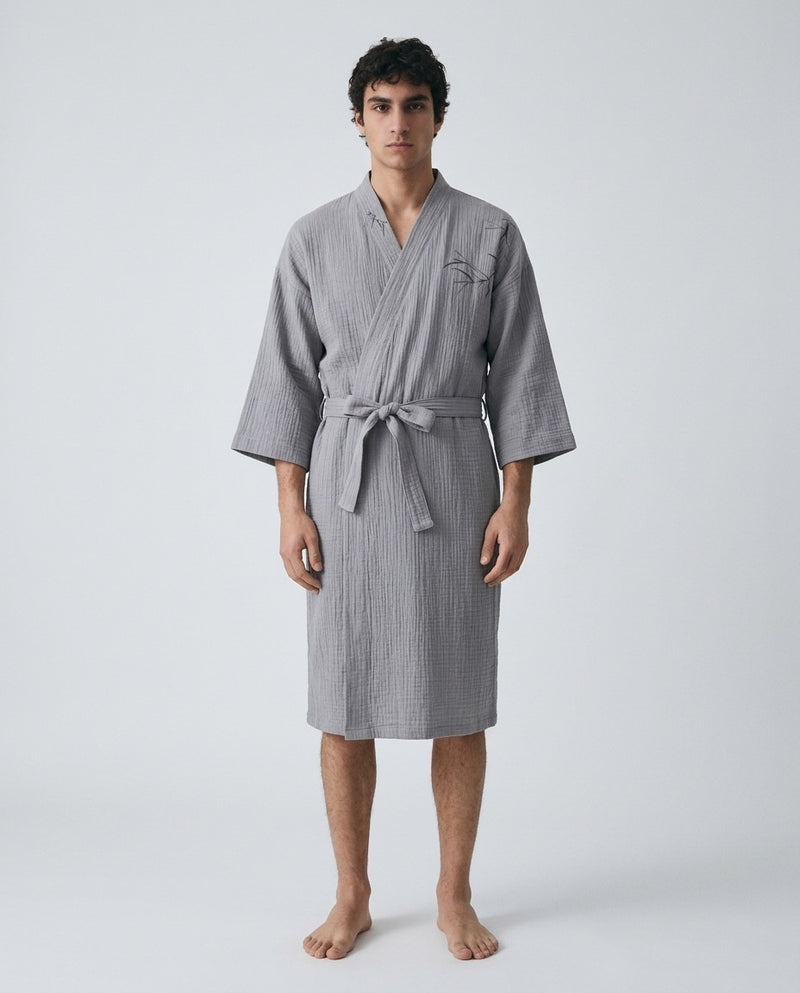

You wear underwear under a yukata, plus one thin layer on top if you are going out: a deep V-neck undershirt for men, and a hadajuban (肌襦袢, a light top worn against the skin) or a yukata slip for women. Wearing nothing at all is how the garment started, since yukata (浴衣) means bath clothing, and it is still normal at a hot spring inn. Men who want less fuss in summer often pick a jinbei (甚平), a two-piece set like the ones in our jinbei collection, which needs nothing special underneath.
Do you wear underwear under a yukata?
Yes. At a summer festival, a fireworks night or a dinner out, people wear ordinary underwear beneath it. What matters is the cut.
For men, briefs or snug boxer briefs beat loose boxers, which bunch up. The men's obi (帯), or sash, sits low on the hips, exactly where a thick waistband would stack under the knot. Before modern underwear, men wore a fundoshi (褌), a wrapped loincloth. You still see it at some festivals, but nobody expects one under a yukata now.
For women, no-show underwear avoids lines through a light yukata. The bra is the bigger question. A yukata is cut to hang straight, like a tube, so a padded or push-up bra pushes the collar open and lifts the obi. A soft wireless bra or a wasou bra (和装ブラ, a kimono bra that flattens the chest) keeps the front smooth.
Do you wear anything under a yukata at a ryokan?
At a ryokan (旅館), a traditional inn, there is usually a yukata folded in your room for the bath, dinner and bed. After a soak in the onsen (温泉), the hot spring bath, plenty of guests put it on over bare skin and sleep that way. That is close to the garment's first job, a robe worn after bathing.
In the halls and the dining room, keep your underwear on. The front opens easily when you sit on tatami mats, kneel at a low table or climb stairs, and women usually keep a bra or camisole on for the same reason. Wrap it left side over right, like every yukata. Right over left is how the dead are dressed for a funeral.
What men wear under a yukata
Two pieces matter most, and the undershirt is the one people get wrong.
| Layer | What works | What to skip |
|---|---|---|
| Underwear | Briefs or snug boxer briefs | Loose boxers that bunch under the obi |
| Top | Deep V-neck undershirt in white or beige, or a men's hadajuban | A crew-neck tee, if you want the traditional look |
| Legs | Suteteko (ステテコ), knee-length undershorts, on humid days | Anything long enough to show at the hem |
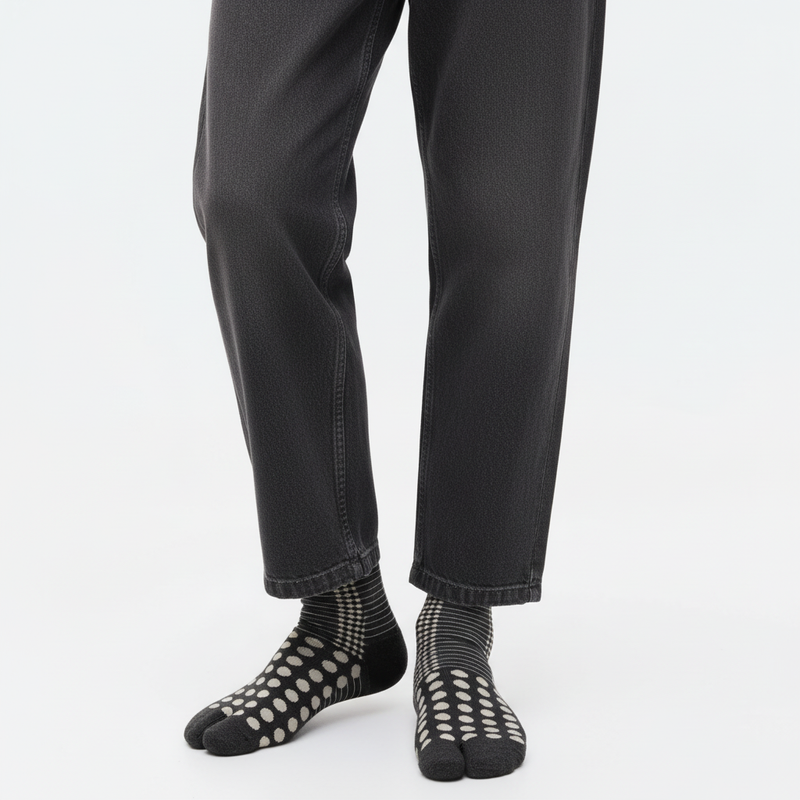
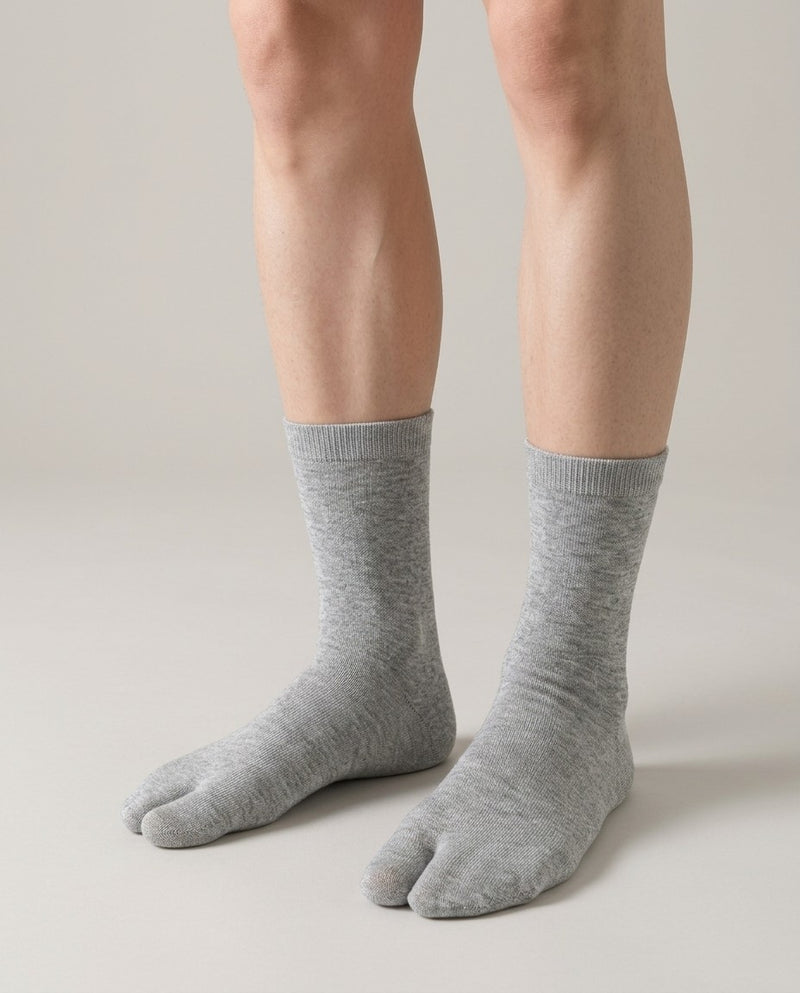
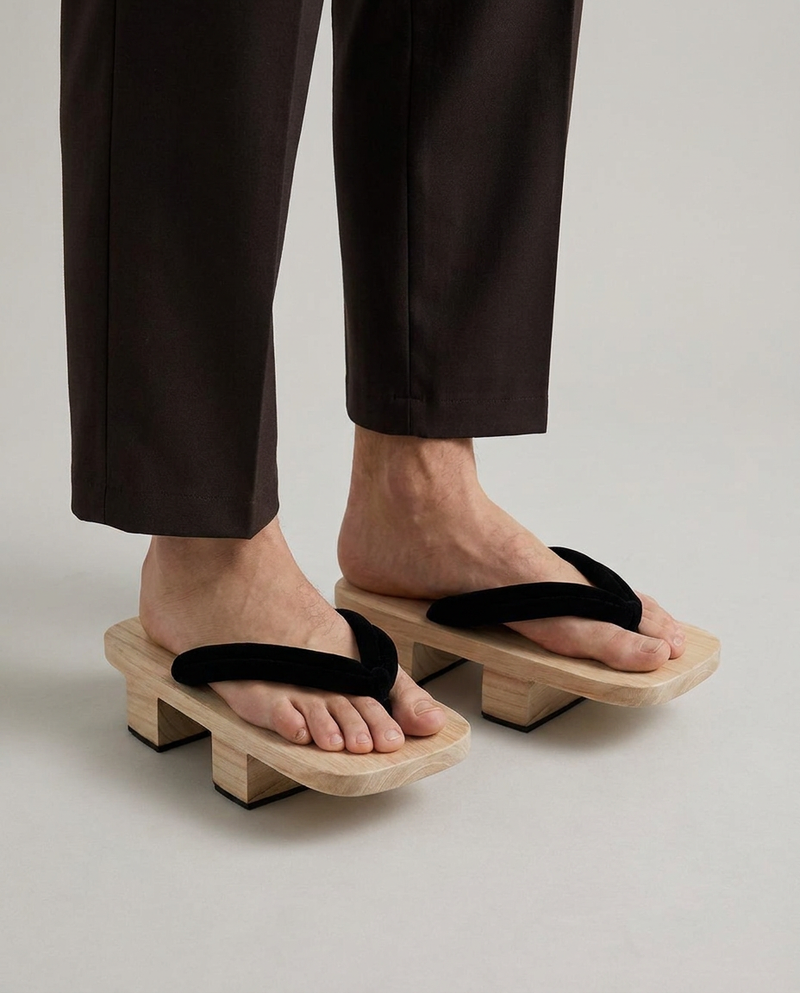
| Feet | Bare feet in geta (下駄), wooden sandals, or split-toe tabi (足袋) socks | Regular socks, which do not fit a thong strap |
The collar of a men's yukata crosses lower than a shirt collar, so a crew neck shows as a white band at the throat. Some men like that as a relaxed look, which is a style choice rather than the traditional one. A layer in August sounds backward, but a thin undershirt soaks up sweat so the yukata does not cling to your back, and suteteko do the same for your legs.
Amaji also sells men's yukata, and this is the layering we would suggest under any of them. For the sash, our guide to the yukata obi covers which belt to wear and how to tie it.
What women wear under a yukata
Women's dressing takes more steps, because the look depends on a smooth, straight line from chest to hip. In the order you put things on:
- A wireless or kimono bra and no-show underwear.
- A hadajuban on top and a susoyoke (裾除け), a wrap underskirt, below. A one-piece yukata slip does both jobs and is the easiest choice the first time. It stops the yukata clinging to your legs as you walk and keeps a light color from turning see-through.
- Padding, called hosei (補正), if you want the classic tube shape. A hand towel folded around the waist fills the curve so the obi sits flat.
- The yukata, left side over right, held with a koshihimo (腰紐), a thin waist tie, before the obi goes on. Our guide on how to wear yukata takes it from there.
One layer you can skip is the nagajuban (長襦袢), the full-length under-robe worn beneath a kimono. A yukata is made to be worn without it. Put a nagajuban and tabi with a yukata and you get a light summer kimono outfit, which follows different rules (see yukata vs kimono).
We don't sell hadajuban, slips or kimono bras at Amaji. A kimono specialist is the place for those.
When a jinbei is the simpler answer
Plenty of men asking this question really want something cool for a summer festival, without wrapping a robe and tying a sash. That is the jinbei's job. It is a short jacket that ties closed at the side, worn with matching shorts or trousers, and in Japan men wear it at home and to summer festivals. Under it you wear your usual underwear, plus a plain tee only if you want one. More on the cut in what is a jinbei.

Amaji's Men's Jinbei Set is $54.90 in Black, Light Grey, Navy or Royal Blue, sizes XS to M. It is a small seller for us: it was in 1 of our last 80 orders over the past 90 days. For a bigger size, the black jinbei set we sell at Amaji ($57.90) runs XS to XXL, the widest size range of our jinbei. Amaji's Seigaiha Wave Jinbei Set ($52.90) has the seigaiha (青海波) pattern of overlapping waves, in Black Wave or Grey Wave, sizes XS and S.

If you stay with the yukata, keep it simple: underwear, one thin layer that hides under the collar, and the left side on top.
Written by the Amaji team, November 13, 2026. How we write our guides.