













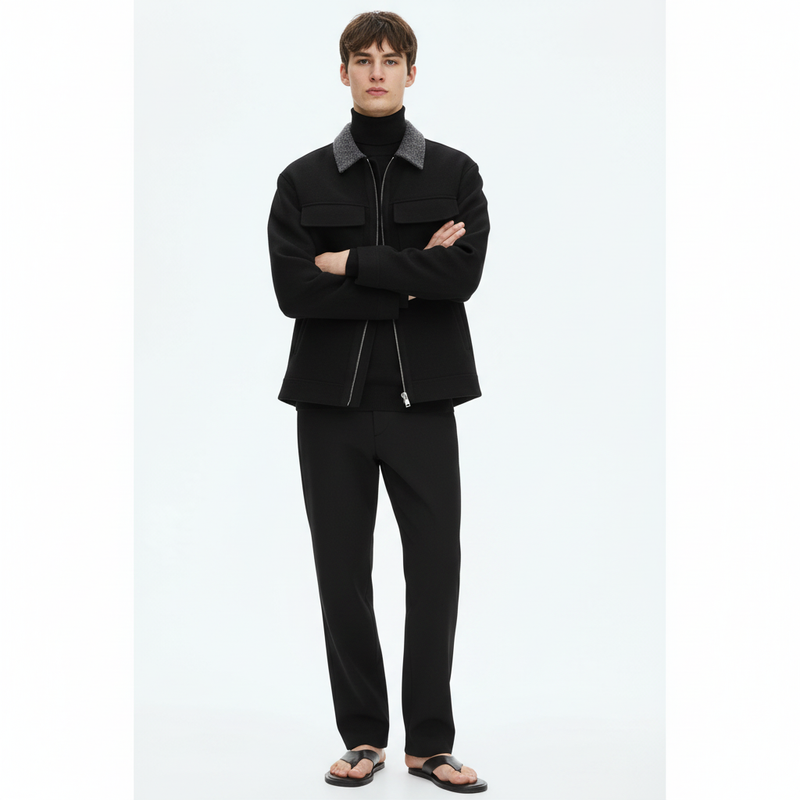


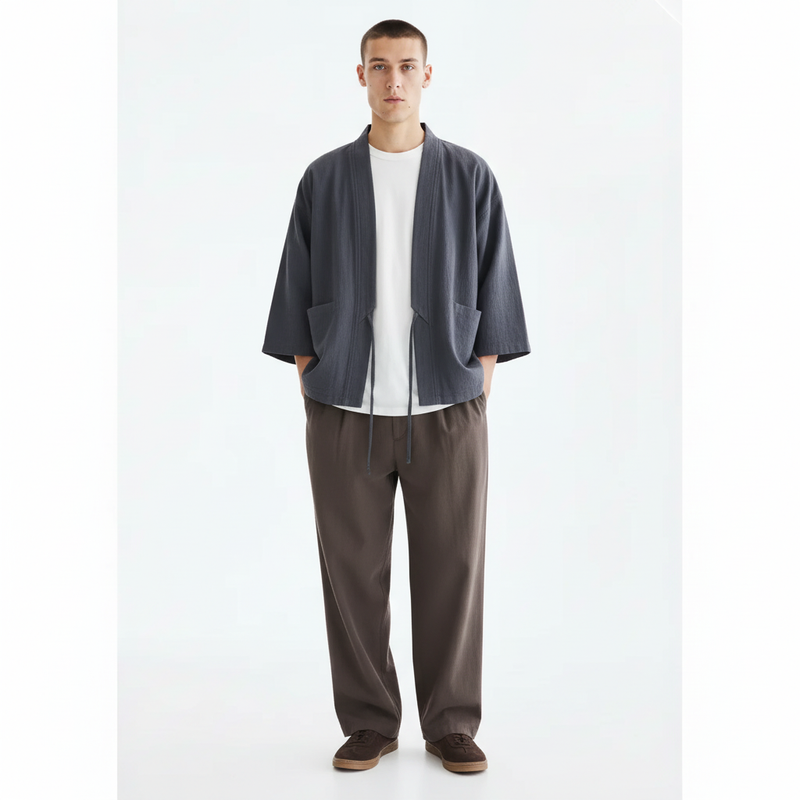
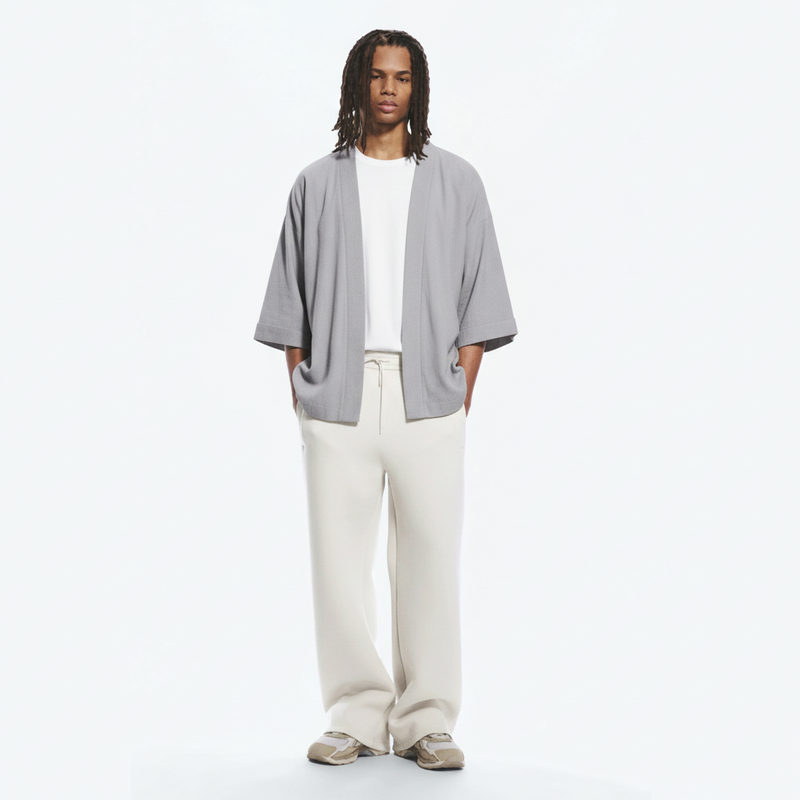
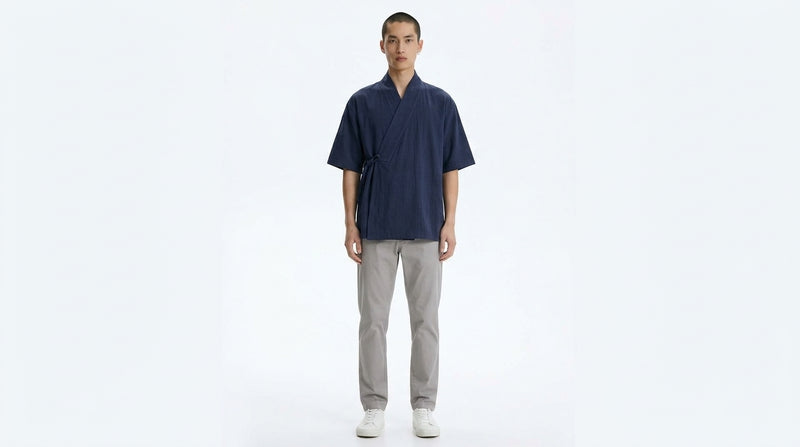



A haori is a short jacket worn over a kimono. Cut like a shortened kimono but without the overlapping front panels, it is designed to hang open, and it is fastened - when it is fastened at all - by a pair of short cords at the chest called haori himo.

Open is the design, not the styling
This is the part that matters and the part most descriptions skip. A kimono crosses over the body and is held shut by an obi. A haori does neither. Its silhouette is defined by how the cloth falls rather than how it wraps, which is exactly why it translates to Western clothing when a kimono does not.
An open-hanging jacket over trousers is a shape the Western eye already reads. Nothing about it needs explaining, and nothing about it requires the rest of the outfit to be Japanese.
What separates it from the things it gets confused with
- Kimono - full length, crosses over, held by an obi. A garment, not a layer.
- Haori - hip or thigh length, hangs open, no belt. A layer worn over the top.
- Noragi - field clothing. Crossover front on a tie, patch pockets, built to work in.
The collar is the giveaway
A haori's collar is narrower than a kimono's and folds back on itself along the front edge rather than crossing the chest. Two thin triangular panels are added at the side seams to give the body width. If a jacket crosses over and ties shut, it is closer to a noragi than a haori, whatever the listing calls it.
Historically, and why the motifs are what they are
The haori was a formal over-garment for samurai-class men in the Edo period, often carrying family crests at the back and shoulders. That is the root of the modern habit of putting a single large graphic across the back - the placement is inherited, not invented.
There is a second inheritance worth knowing about. Because the outside of a formal haori was kept restrained, the lining became the place where decoration went - elaborate scenes on the inside of a plain black jacket, visible only to the wearer and only when it moved. If you have wondered why so many haori are sold with a printed interior, that is why.
The cords, and whether you need them
Haori himo are the short cords that fasten across the chest. They attach to small loops sewn inside the front edges and are usually tied once and then left tied, so the jacket is slipped on and off with the knot intact. Plenty of modern haori omit them entirely and are meant to hang open, which is worth checking before you buy if you wanted the option of closing it.
Length tells you the register
Haori run anywhere from hip to mid-thigh. Shorter reads sharper and sits better over trousers with volume; longer reads more traditional and wants something narrow underneath. Neither is more correct - but the length is the single biggest thing deciding whether the jacket looks like clothing or like costume, so it is worth deciding deliberately rather than taking whatever arrives.
What to wear it over
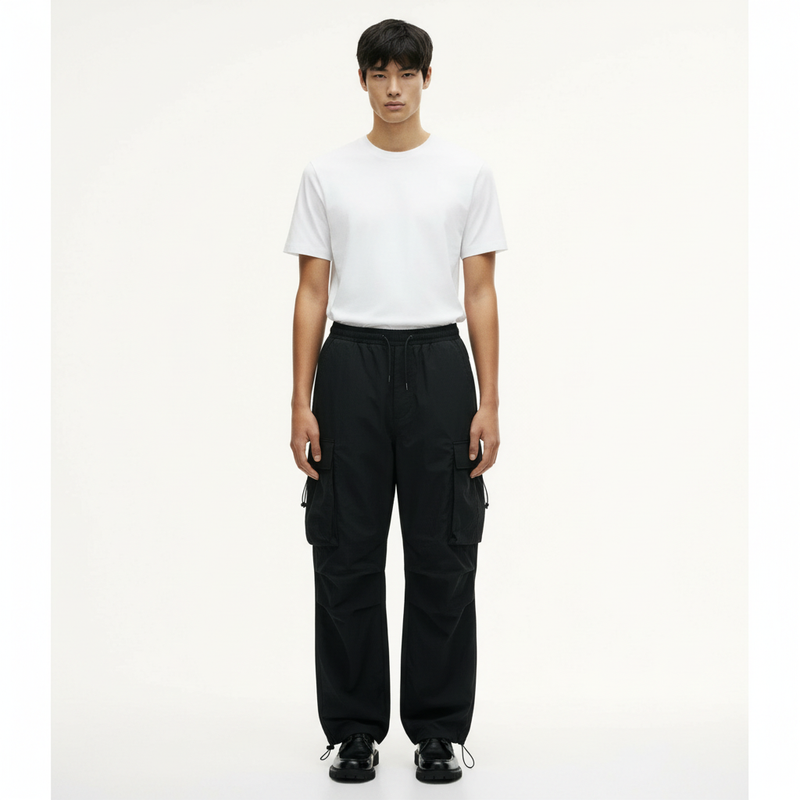
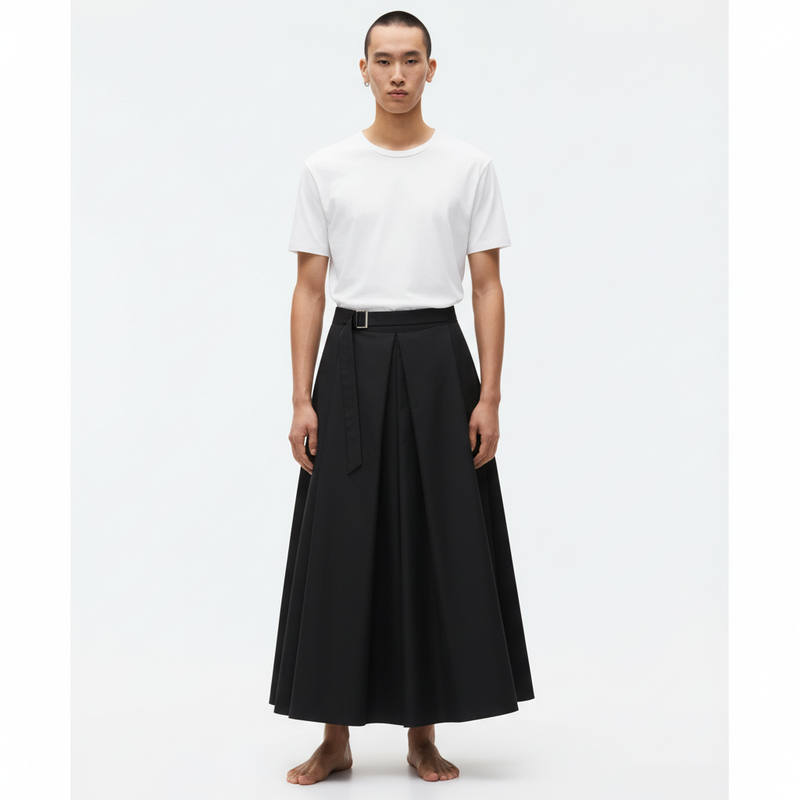
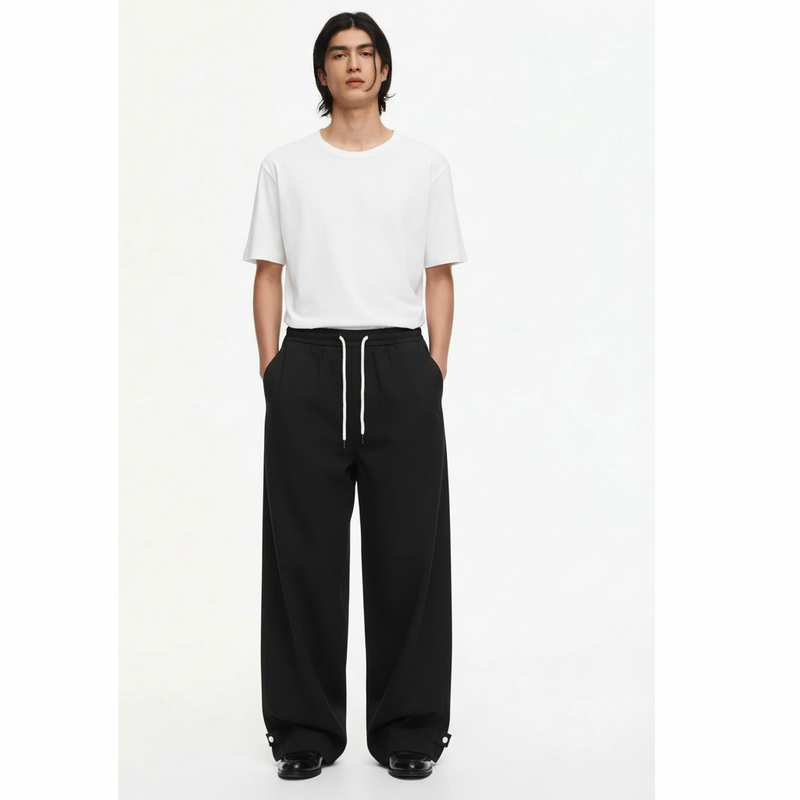
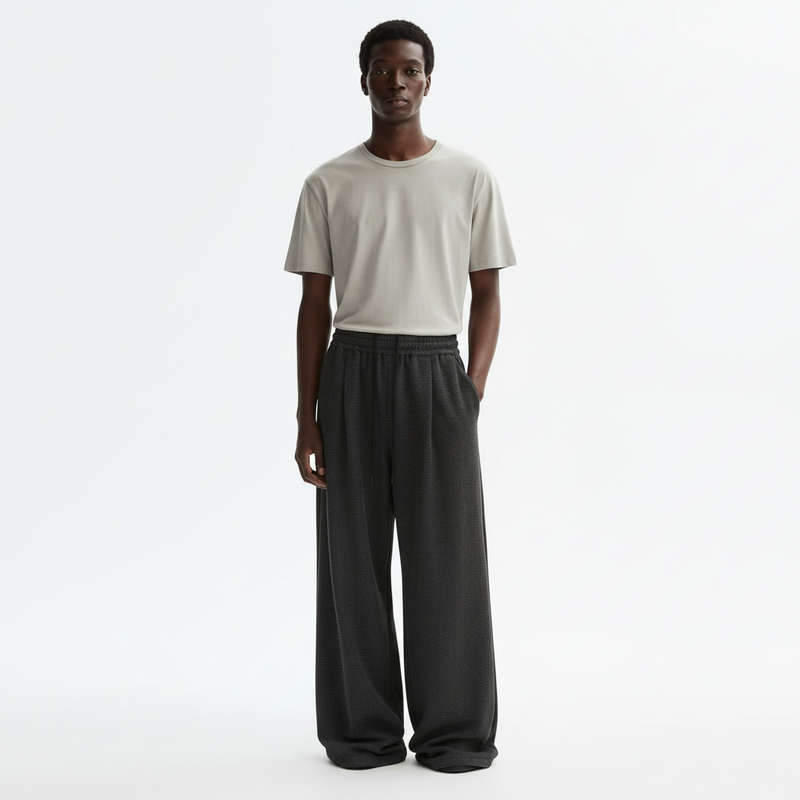
It sits over a plain tee or a crew knit without competing, and over wide trousers it reads as one deliberate line rather than two loose garments. The thing to avoid is layering it over something equally voluminous on top; the haori supplies the volume, so what goes underneath should be quiet.
What we stock
The Indigo Kendo Haori Jacket is the strict version - collarless neckline, straight button front, one chest pocket, squared hem, in dense indigo cotton that is dry to the touch. The Reversible Denim Noragi Robe is the relaxed one: shawl collar, waist tie, patch pockets, crinkled cotton-linen. The Open-Front Cotton Haori Jacket is the plainest of the three: a straight body in light textured cotton, a collar band down both fronts and nothing to fasten. All three sit in Haori, and the closely related field cut is in Noragi Jackets.
If you want the garment rather than the layer, that is a kimono or a yukata, and the difference between those two is worth knowing first.
Worth knowing before you buy
Haori are cut short and wide, so the useful measurement is the shoulder and the sleeve, not the chest - the body is meant to hang away from you. Size runs on traditional cuts are often narrow; check the size chart rather than assuming your usual letter.
For all sixteen garments in one place, with their Japanese names, see traditional Japanese clothing.