


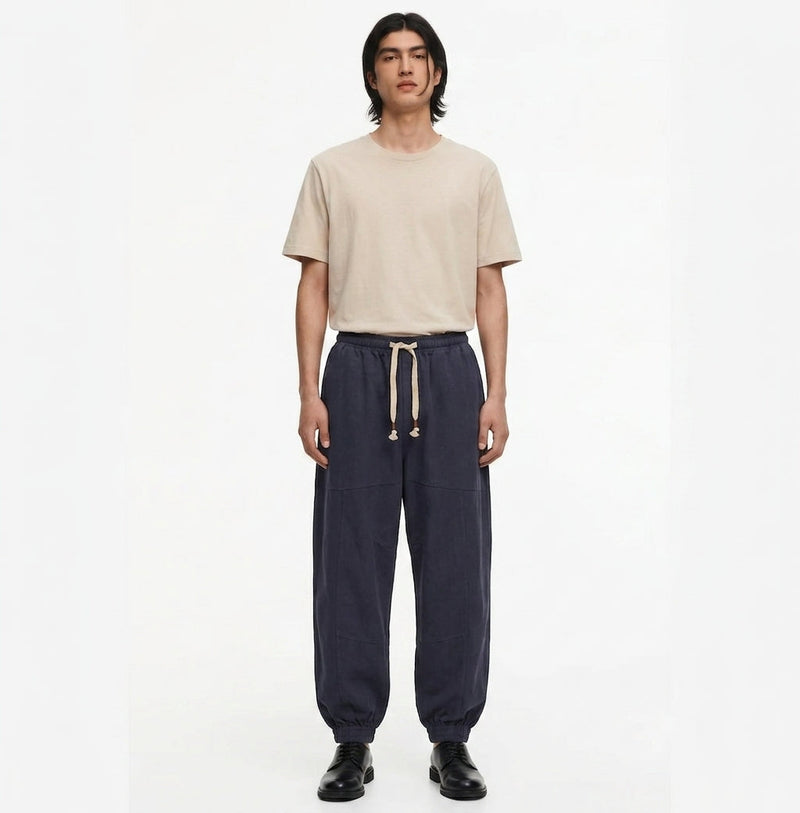

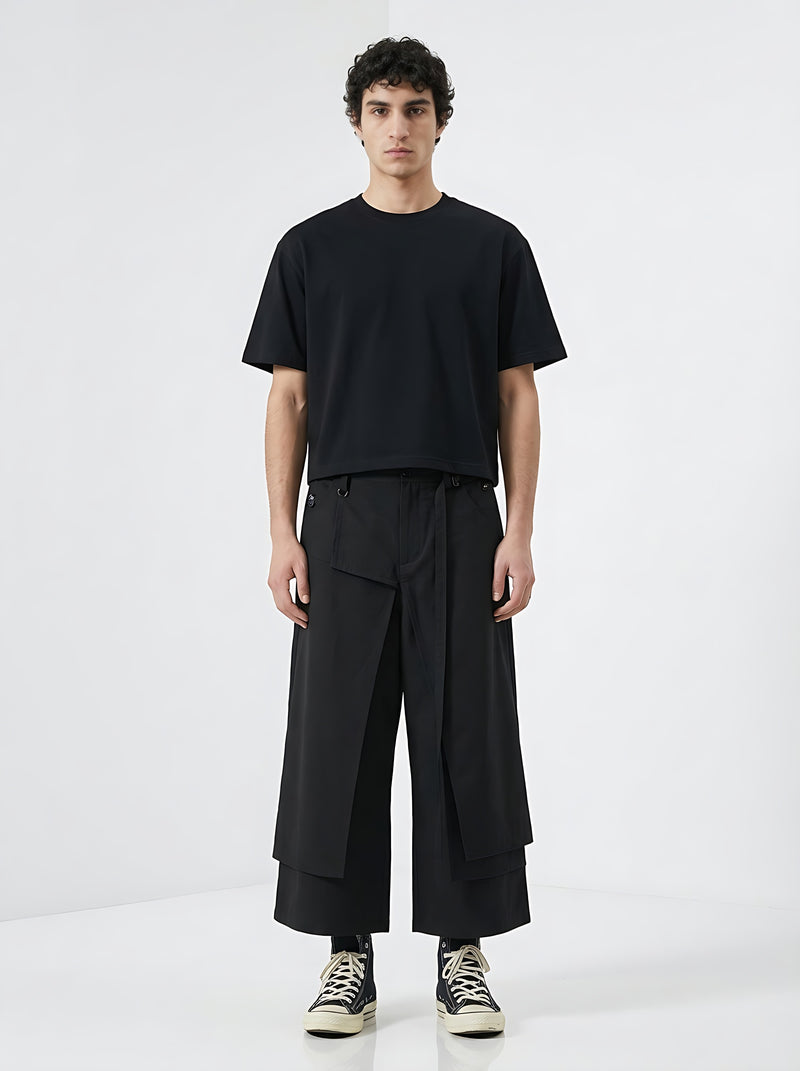

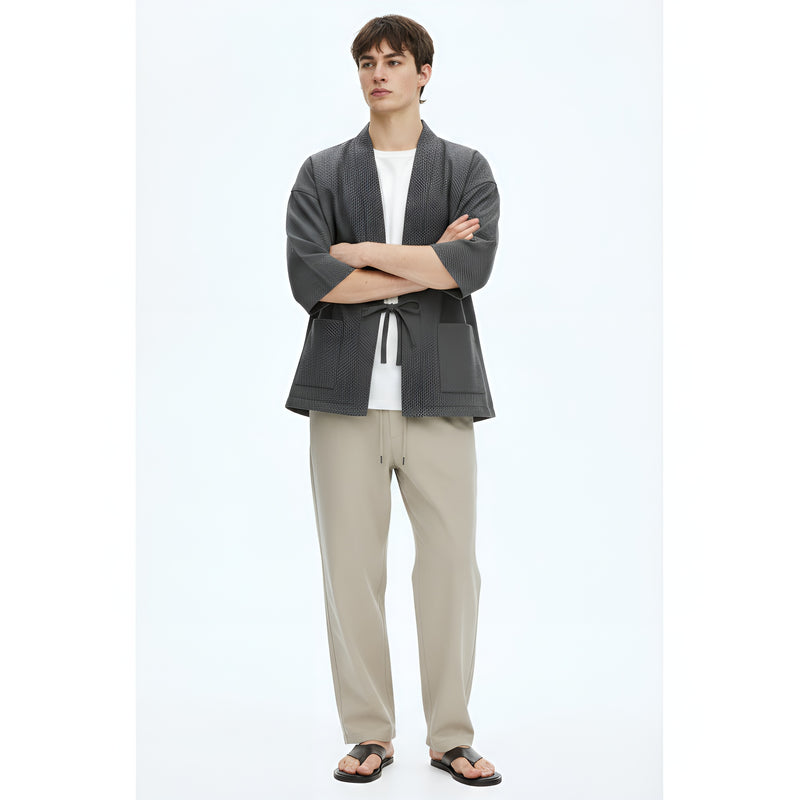


An outseam measurement is the length of the outside of a trouser leg, taken from the waistband straight down to the hem. It is the longer of the two length measurements a pair of trousers has, and it is the one most Asian-market size charts actually publish.
Learning how to measure pants outseam takes about two minutes. Getting it right takes one extra decision that almost nobody tells you about, so we will come to that after the definition.
What an outseam measurement is, precisely
Take a pair of trousers and lay them flat. The outer edge of the leg runs unbroken from the waistband to the hem, usually with a seam along it. The length of that edge is the outseam.
It includes the rise, meaning everything between the waistband and the crotch. The inseam does not. So on any given pair, the outseam is always the larger figure, by the depth of the rise.
Some brands call it the outside leg, the side seam length, or simply the length. On Amaji product charts it appears as length.
Outseam and inseam, side by side
- Outseam. Waistband to hem, down the outside. Includes the rise. Describes how much leg the garment covers.
- Inseam. Crotch to hem, down the inside. Excludes the rise. Describes where the hem lands relative to your leg.
- The gap between them. The rise, typically 25 cm to 32 cm on trousers and 28 cm to 30 cm on shorts.
Neither is better. They answer different questions, and a chart that gives you only one is asking you to work out the other.
What you need
A soft tape measure, a flat table or floor, and the trousers off your body. A rigid builder's tape works at a push, but it will not sit flat over a waistband seam.
Skip the string-and-ruler method. It builds in slack, and slack always reads long.
Decide where the waistband starts
Here is the decision that changes your answer by four or five centimetres.
Some charts take the outseam from the very top edge of the waistband. Others start at the seam where the waistband is joined to the leg panel. On a trouser with a 5 cm elasticated waistband, those two starting points give you two different trousers.
If a chart does not say, assume the top edge, since that is the more common convention. Then treat the difference as part of the 2 cm to 3 cm tolerance that any hand measurement carries anyway.
The important thing is consistency. Measure your own pair the same way every time, and you can compare it to anything.
The flat method, step by step
- Lay the trousers flat, front side up, and smooth out every crease and fold.
- Stack the legs squarely on top of one another so the side seam sits along the outer edge.
- Put the end of the tape at the top edge of the waistband, on the outer side.
- Run the tape straight down the outer edge to the bottom of the hem.
- Keep the tape flat and untensioned. Do not follow the flare of a wide leg.
- Read the number where the hem ends. That is the outseam.
Do a second pass on the other leg. If the two differ by more than a centimetre, the trousers are not lying square, so reset them and go again.
Measuring the outseam on shorts
Identical method, much smaller number. Shorts are almost always sold on outseam rather than inseam, because an inseam on a short leg is a nearly useless figure. Two shorts with the same 5 inch inseam can sit at very different points on the thigh depending on the rise.
The Oversized Shorts in heavyweight cotton report 45 cm at S, rising to 46.5 cm at M and 48 cm at L. Those are outside lengths from waistband to hem, which is why a 45 cm figure describes a short that lands near the knee rather than a knee-length trouser.
When a shorts listing quotes a length in inches without saying which, it is the outseam. A 7 inch inseam and a 7 inch outseam are entirely different garments.
Measuring your own outseam
A body outseam is worth having if you are ordering made-to-measure or buying workwear.
Stand upright in the shoes you plan to wear. Find the top of your hip bone, then run the tape from your natural waist straight down the outside of the leg to the floor, or to wherever you want the hem to fall. Keep the tape against the body without pressing in.
Ask somebody else to read it if you can. Bending to look at the tape shortens the measurement every time.
Reading the number against a size chart
Every Amaji product page carries the manufacturer's own flat measurement chart for that garment, transcribed and converted to centimetres. On bottoms, the column labelled length is the outside length, not the inseam.
The Cotton Linen Wide-Leg Pants read 102 cm at S, 104 cm at M and 106 cm at L, moving 2 cm per size. The Striped Wide-Leg Track Pants run 98, 100 and 102 cm over the same three sizes. Those are outseams.
So the useful comparison is straightforward: measure the outseam of a pair you already own and like, then look for the row closest to it. Comparing a garment against a garment beats comparing a body against a chart, every time. Our how we measure page explains what each column means and where the figures come from.
Converting an outseam to an inseam
Subtract the rise. Since most listings do not publish the rise, the table below assumes a typical shorts rise of 28 cm to 30 cm, or roughly 11 to 12 inches.
| Outseam | Approximate inseam | Where the hem sits |
|---|---|---|
| 15 in / 38 cm | 3 to 4 in / 8 to 10 cm | Upper thigh |
| 16 in / 41 cm | 4 to 5 in / 10 to 13 cm | Mid thigh |
| 17 in / 43 cm | 5 to 6 in / 13 to 15 cm | Above the knee |
| 18 in / 46 cm | 6 to 7 in / 15 to 18 cm | Just above the knee |
| 19 in / 48 cm | 7 to 8 in / 18 to 20 cm | At the knee |
Treat it as an estimate, not a conversion. A dropped or high rise moves every row. If the exact figure matters, measure the inseam directly on a pair you own.
On full-length trousers, subtract 25 cm to 32 cm instead, taking the higher end for a high-waisted or dropped-crotch cut. So an inseam of 28 in on a trouser with a 28 cm rise puts the outseam near 39 in, and the same 28 in inseam on a high-waisted cut with a 32 cm rise pushes it closer to 41 in.
Why some brands publish one and not the other
It is largely a regional habit. American denim grew up on waist and inseam, which is why a label reads 32 x 34. Much of the rest of the market measures the garment flat and reports its total length.
That convention shows up clearly in our own catalogue. Across the 98 charts on the site, the word inseam does not appear once, and all 22 charts covering bottoms give an outside length instead.
So if a number looks impossibly large, it is almost certainly an outseam. A 102 cm figure on the Quick-Dry Cargo Joggers at size S is an outside length. As an inseam it would fit nobody.
What the outseam will not tell you
It is a single vertical line, so it says nothing about width.
Two pairs with an identical outseam can have a 44 cm leg opening or a 52 cm one, and they will look nothing alike. The wide-leg cuts make that obvious: a wider hem drapes lower over the shoe, so the trouser reads longer than the tape says.
It also says nothing about the rise, which is the measurement that actually decides how a pair feels when you sit down.
Four ways this goes wrong
- Pulling the tape tight. Tension stretches soft fabric and adds length that is not there.
- Following the flare. On a wide leg the outer edge curves outward. Measure the straight vertical drop.
- Measuring them on. Worn trousers ride up at the waist and bunch at the ankle.
- Ignoring the fabric. Linen relaxes with wear and washing. A woven cotton twill barely moves.
Where to go next
For the seam on the inside of the leg, see where the inseam is on pants, and for decoding a label like 32 x 34, try length versus inseam. If the answer is that your trousers are simply too long, the cost of hemming pants covers what to expect to pay. Browse the range in pants and shorts.